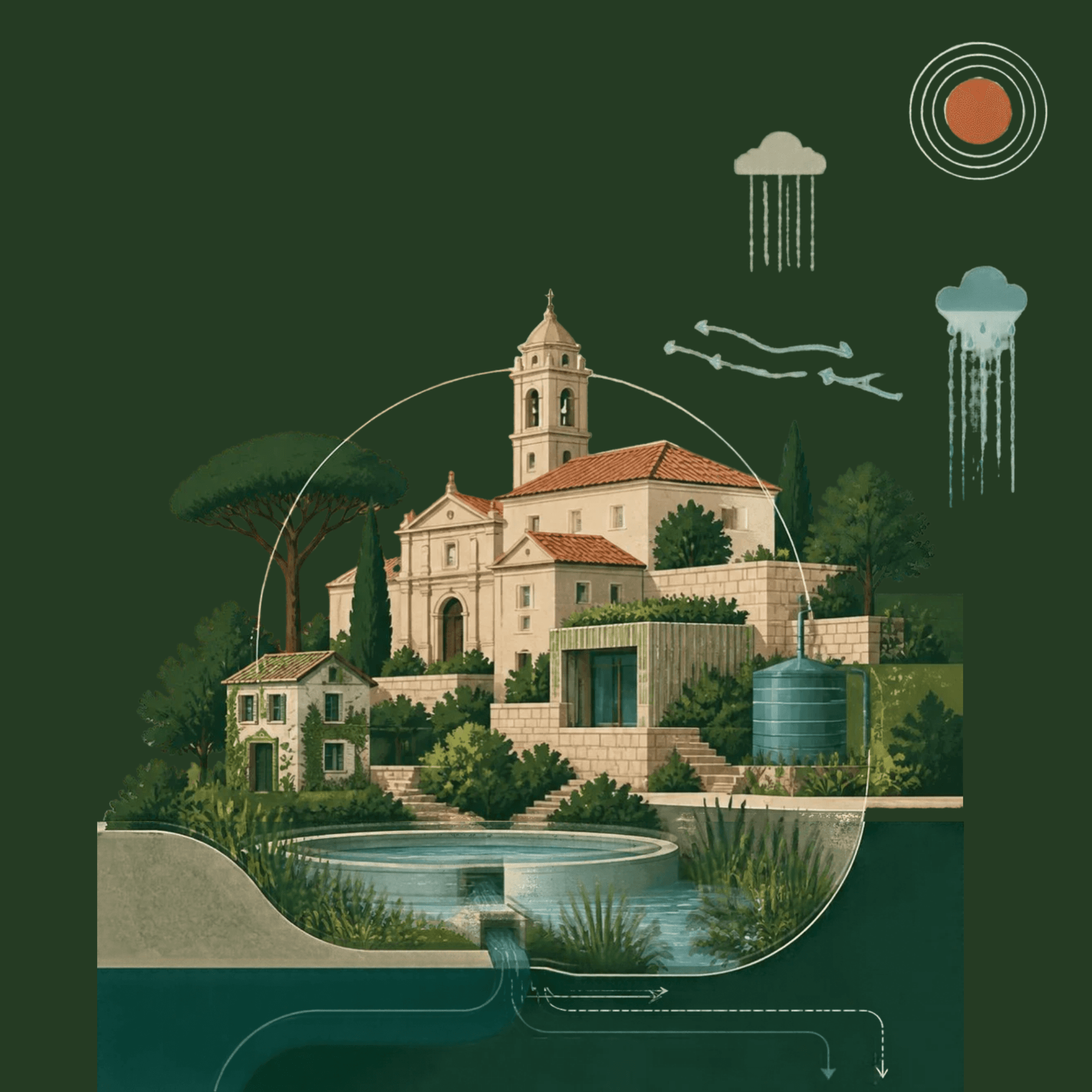
Heritage Climate Resilience Service
Overview
Designing a connected public service for climate-related risks to cultural heritage.
The project explores how a digital service could help heritage site owners and managers understand climate-related risks, respond to damage, navigate legal and administrative procedures, and plan long-term adaptation measures.
Rather than designing another reporting form, the challenge is to connect a fragmented ecosystem of institutions, data sources, regulations and specialist services into a coherent end-to-end experience.
The work combines user and stakeholder research, ecosystem mapping, current-state journey analysis, service blueprinting, future-state service design, data, public-sector processes, technology and outcome measurement.
My role
I worked on the project from a research and service-design perspective, connecting the needs of heritage managers with institutional responsibilities, climate data and the realities of public-sector processes.
My contribution included:
framing the service problem;
structuring research questions;
analysing the current experience of heritage managers;
identifying actors, dependencies and gaps in the existing ecosystem;
translating research and institutional knowledge into service requirements;
developing the current-state journey;
proposing the structure of the service blueprint;
defining key service stages and touchpoints;
contributing to the concept of the digital service;
connecting heritage-management needs with climate-risk information;
defining what information should be collected during a climate-related incident;
developing future-state scenarios and service opportunities.
Some decisions were within my direct area of responsibility, particularly research synthesis, experience mapping and service concept development.
Other decisions — especially those concerning climate methodology, legal interpretation, institutional responsibilities and technical feasibility — required collaboration with NID experts, IOŚ specialists and other stakeholders.
This distinction was important: my role was not to independently define legal or scientific rules, but to translate expert knowledge into a coherent service experience.
Categories
SERVICE DESIGN
Ecosystem Mapping
Client
Public Sector


Core Problem Statement
Today, when a heritage site is affected by climate-related impacts — such as flooding, extreme rainfall, strong winds or prolonged drought — information about the incident, the required response and available support is distributed across multiple systems, institutions and administrative processes.
Under Polish heritage protection law, the owner or holder of a protected heritage asset is responsible for its maintenance and safeguarding.
If a monument entered in the heritage register or included in the provincial heritage inventory is damaged or threatened, the competent Voivodeship Heritage Protection Officer must be notified within the statutory deadline.
If the incident also qualifies as a construction disaster, an additional emergency process is triggered.
Once the immediate threat has been addressed, another layer of complexity appears: conservation approvals, building procedures, specialist assessments, repairs and potential funding.
From June 2026, some heritage-related activities may also follow a notification procedure in which the absence of an objection within 60 days can constitute approval. Core works affecting registered monuments, however, remain subject to conservation oversight.
The result is a service ecosystem in which the heritage manager must understand not only what happened, but also which procedure applies, which institution is responsible, what evidence is required and what should happen next.
If a heritage asset has been damaged, information regarding the incident is not consolidated in a single place that addresses all the key aspects: what happened, the severity of the risk, immediate actions to take, whom to notify, what data to collect, how to plan remedial measures, and how to mitigate the impact of similar events in the future.
There is no single service layer connecting the incident, the heritage asset and the response.
Research & Discovery
The ecosystem includes organisations responsible for heritage protection, emergency response, building safety, climate information, funding, technical expertise and long-term adaptation.
NID acts primarily as an expert and advisory institution. Within the proposed service, it could also become the national knowledge layer collecting structured evidence about the impact of climate change on cultural heritage.
How I defined the problem ?
Initially, the application could have been approached primarily as a damage-reporting tool.
I considered this too narrow.
A reporting form only addresses one moment in the journey — after the damage has already occurred.
By mapping the broader context, I identified opportunities both before and after the incident:
before: risk awareness and preparation;
during: guided response;
after: recovery, learning and adaptation.
This led me to reframe the concept from: damage reporting to: climate resilience service.
Define & Strategy
The ecosystem map showed who is involved.
The current-state journey was needed to understand what the heritage manager actually experiences over time.
I used an extreme rainfall scenario because it allows the service to be examined across emergency response, damage documentation, conservation requirements, repair and adaptation.
How I moved from journey mapping to service opportunities?
I grouped the pain points into four broader needs.
Need 1 — Understand The manager needs to know: | Need 2 — Prepare The manager needs to know: What can I do before the event? |
Need 3 — Respond The manager needs to know: What should I do now? | Need 4 — Adapt The manager needs to know: What should change afterwards? |
These needs later became the four core modes of the service:
KNOW → PREPARE → RESPOND → ADAPT
This structure was therefore not created as a navigation concept first.
It emerged from the current-state journey and identified user needs.
Ideation & Design Process
Why a service blueprint?
A user journey alone could not capture the complexity of the proposed service.
Many important activities would happen outside the user's view:
connecting heritage records;
processing climate information;
validating data;
applying decision rules;
coordinating institutional knowledge;
updating the risk profile.
This made it possible to identify not only what the user should see, but also what needs to happen organisationally and technically for that experience to work.
The ecosystem includes organisations responsible for heritage protection, emergency response, building safety, climate information, funding, technical expertise and long-term adaptation.
NID acts primarily as an expert and advisory institution. Within the proposed service, it could also become the national knowledge layer collecting structured evidence about the impact of climate change on cultural heritage.
Final Design
The proposed Heritage Resilience service connects the heritage manager's journey with NID's knowledge layer, external institutions, climate data and administrative processes.
The blueprint is structured around eight stages.

Testing & Validation
Until the service is legally and technically integrated with public-administration systems needs validation.
The underlying methodology has recently been developed by NID in cooperation with IOŚ. The methodology itself is internal and subject to NDA.
The adaptation measures allow the service to move from generic climate information towards recommendations relevant to a specific heritage asset.
Results & Impact
Until the service is legally and technically integrated with public-administration systems needs validation.
The underlying methodology has recently been developed by NID in cooperation with IOŚ. The methodology itself is internal and subject to NDA.
The adaptation measures allow the service to move from generic climate information towards recommendations relevant to a specific heritage asset.
Reflections
The application concept has been documented as part of a proposal for funding under the national heritage recovery programme.
Heritage Climate Resilience Service
Overview
Designing a connected public service for climate-related risks to cultural heritage.
The project explores how a digital service could help heritage site owners and managers understand climate-related risks, respond to damage, navigate legal and administrative procedures, and plan long-term adaptation measures.
Rather than designing another reporting form, the challenge is to connect a fragmented ecosystem of institutions, data sources, regulations and specialist services into a coherent end-to-end experience.
The work combines user and stakeholder research, ecosystem mapping, current-state journey analysis, service blueprinting, future-state service design, data, public-sector processes, technology and outcome measurement.
My role
I worked on the project from a research and service-design perspective, connecting the needs of heritage managers with institutional responsibilities, climate data and the realities of public-sector processes.
My contribution included:
framing the service problem;
structuring research questions;
analysing the current experience of heritage managers;
identifying actors, dependencies and gaps in the existing ecosystem;
translating research and institutional knowledge into service requirements;
developing the current-state journey;
proposing the structure of the service blueprint;
defining key service stages and touchpoints;
contributing to the concept of the digital service;
connecting heritage-management needs with climate-risk information;
defining what information should be collected during a climate-related incident;
developing future-state scenarios and service opportunities.
Some decisions were within my direct area of responsibility, particularly research synthesis, experience mapping and service concept development.
Other decisions — especially those concerning climate methodology, legal interpretation, institutional responsibilities and technical feasibility — required collaboration with NID experts, IOŚ specialists and other stakeholders.
This distinction was important: my role was not to independently define legal or scientific rules, but to translate expert knowledge into a coherent service experience.
Categories
SERVICE DESIGN
Ecosystem Mapping
Client
Public Sector
Core Problem Statement
Today, when a heritage site is affected by climate-related impacts — such as flooding, extreme rainfall, strong winds or prolonged drought — information about the incident, the required response and available support is distributed across multiple systems, institutions and administrative processes.
Under Polish heritage protection law, the owner or holder of a protected heritage asset is responsible for its maintenance and safeguarding.
If a monument entered in the heritage register or included in the provincial heritage inventory is damaged or threatened, the competent Voivodeship Heritage Protection Officer must be notified within the statutory deadline.
If the incident also qualifies as a construction disaster, an additional emergency process is triggered.
Once the immediate threat has been addressed, another layer of complexity appears: conservation approvals, building procedures, specialist assessments, repairs and potential funding.
From June 2026, some heritage-related activities may also follow a notification procedure in which the absence of an objection within 60 days can constitute approval. Core works affecting registered monuments, however, remain subject to conservation oversight.
The result is a service ecosystem in which the heritage manager must understand not only what happened, but also which procedure applies, which institution is responsible, what evidence is required and what should happen next.
If a heritage asset has been damaged, information regarding the incident is not consolidated in a single place that addresses all the key aspects: what happened, the severity of the risk, immediate actions to take, whom to notify, what data to collect, how to plan remedial measures, and how to mitigate the impact of similar events in the future.
There is no single service layer connecting the incident, the heritage asset and the response.
Research & Discovery
The ecosystem includes organisations responsible for heritage protection, emergency response, building safety, climate information, funding, technical expertise and long-term adaptation.
NID acts primarily as an expert and advisory institution. Within the proposed service, it could also become the national knowledge layer collecting structured evidence about the impact of climate change on cultural heritage.
How I defined the problem ?
Initially, the application could have been approached primarily as a damage-reporting tool.
I considered this too narrow.
A reporting form only addresses one moment in the journey — after the damage has already occurred.
By mapping the broader context, I identified opportunities both before and after the incident:
before: risk awareness and preparation;
during: guided response;
after: recovery, learning and adaptation.
This led me to reframe the concept from: damage reporting to: climate resilience service.
Define & Strategy
The ecosystem map showed who is involved.
The current-state journey was needed to understand what the heritage manager actually experiences over time.
I used an extreme rainfall scenario because it allows the service to be examined across emergency response, damage documentation, conservation requirements, repair and adaptation.
How I moved from journey mapping to service opportunities?
I grouped the pain points into four broader needs.
Need 1 — Understand The manager needs to know: | Need 2 — Prepare The manager needs to know: What can I do before the event? |
Need 3 — Respond The manager needs to know: What should I do now? | Need 4 — Adapt The manager needs to know: What should change afterwards? |
These needs later became the four core modes of the service:
KNOW → PREPARE → RESPOND → ADAPT
This structure was therefore not created as a navigation concept first.
It emerged from the current-state journey and identified user needs.
Ideation & Design Process
Why a service blueprint?
A user journey alone could not capture the complexity of the proposed service.
Many important activities would happen outside the user's view:
connecting heritage records;
processing climate information;
validating data;
applying decision rules;
coordinating institutional knowledge;
updating the risk profile.
This made it possible to identify not only what the user should see, but also what needs to happen organisationally and technically for that experience to work.
The ecosystem includes organisations responsible for heritage protection, emergency response, building safety, climate information, funding, technical expertise and long-term adaptation.
NID acts primarily as an expert and advisory institution. Within the proposed service, it could also become the national knowledge layer collecting structured evidence about the impact of climate change on cultural heritage.
Final Design
The proposed Heritage Resilience service connects the heritage manager's journey with NID's knowledge layer, external institutions, climate data and administrative processes.
The blueprint is structured around eight stages.
Testing & Validation
Until the service is legally and technically integrated with public-administration systems needs validation.
The underlying methodology has recently been developed by NID in cooperation with IOŚ. The methodology itself is internal and subject to NDA.
The adaptation measures allow the service to move from generic climate information towards recommendations relevant to a specific heritage asset.
Results & Impact
Until the service is legally and technically integrated with public-administration systems needs validation.
The underlying methodology has recently been developed by NID in cooperation with IOŚ. The methodology itself is internal and subject to NDA.
The adaptation measures allow the service to move from generic climate information towards recommendations relevant to a specific heritage asset.
Reflections
The application concept has been documented as part of a proposal for funding under the national heritage recovery programme.



Book a call, and I’ll take care of the rest
Book a call, and I’ll take care of the rest
Book a call, and I’ll take care of the rest